
Replication Certification at Publication: Checkable by Anyone, Anywhere, in Seconds, Forever
Gary King, Yiqing Xu, Leo Y. Yang. 2026.
"Replication Certification at Publication: Checkable by Anyone, Anywhere, in Seconds, Forever".
Abstract
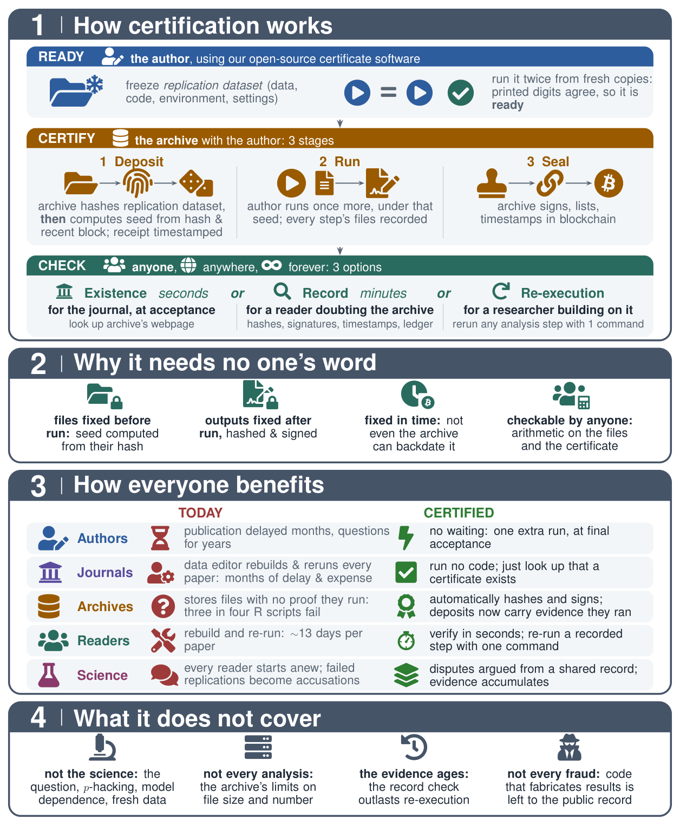
Authors increasingly deposit replication datasets—the data and code behind publications—in archives, and journals increasingly require them to, under progressively onerous rules. But a deposit alone proves little, so authors keep paying: months for the journal’s reanalyses, years answering readers’ questions, and rancor as failed replications become accusations because no record establishes what actually ran. We introduce a replication certificate: a cryptographically signed record of the deposited files and logged output. It replaces the journal’s reanalyses with evidence anyone can check in seconds, which no one, including the archive, can backdate, and no one can fake without risking detection. Certification asks little of anyone and benefits everyone: The author deposits, then reruns the analysis once under a random seed the archive computes from the deposit’s hash and a blockchain block; the archive signs, timestamps (in that blockchain), and stores the record—confidential data included—without rerunning anything; the journal merely checks a website for the certificate; and anyone can check or replay any step decades later.
See Also
- [Paper] Publication, Publication (2006)
- [Paper] Replication, Replication (1995)
- [Dataset] Replication Data For: Explaining Systematic Bias and Nontransparency in U.S. Social Security Administration Forecasts. (2015)
- [Dataset] Replication Data For: Systematic Bias and Nontransparency in U.S. Social Security Administration Forecasts. (2015)
- [Dataset] Replication Data For: Public Policy for the Poor? A Randomised Assessment of the Mexican Universal Health Insurance Programme (2009)
- [Paper] The Future of Replication (2003)
- [Paper] A Digital Library for the Dissemination and Replication of Quantitative Social Science Research (2001)
- [Paper] Precision Mapping Child Undernutrition for Nearly 600,000 Inhabited Census Villages in India (2021)